

TensorFlow张量提取与赋值:tf.gather系列与tf.scatter_nd系列详解

本文深入解析TensorFlow中张量的提取与赋值操作。详细讲解tf.gather和tf.gather_nd从指定位置收集数值的方法,以及tf.scatter_nd和tf.scatter_nd_update将更新值写入张量的机制。通过函数原型、参数说明及代码示例,阐明索引维度与输出形状的关系,帮助开发者掌握高效处理张量数据的核心技巧。
TensorFlow张量提取与赋值概述
在TensorFlow中,tf.gather和tf.gather_nd用于从参数张量params中收集特定数值,而tf.scatter_nd和tf.scatter_nd_update则用于将updates中的值更新到目标张量的指定位置。严格来说,tf.gather_nd与tf.scatter_nd_update互为逆操作。
当已知数值在张量中的具体位置时,可以使用tf.gather或tf.gather_nd来提取这些数值。
在tf.gather中,indices的每个元素(标量)代表params中某个axis的索引;而在tf.gather_nd中,indices的最后一阶对应于具体的索引值。
tf.gather系列:张量数值提取
tf.gather函数详解
函数原型如下所示。
gather(
 params,
 indices,
 validate_indices=None,
 name=None,
 axis=0
)
其中,params是待查找的源张量,indices是包含待查找值索引的张量(类型为int32或int64),axis指定查找的轴,name为可选的操作名称。
当indices为标量时:

当indices为向量时:

当indices为高阶张量时:

关于返回值:
该函数的返回值类型与params保持一致,具体数值是从params中根据indices收集而来,其输出形状由indices的形状和params中对应切片决定。

tf.gather_nd:高阶索引提取
tf.gather_nd函数详解
函数原型如下所示。
gather_nd(
 params,
 indices,
 name=None
)
indices是一个K阶张量,包含K-1阶的索引值。其最后一阶表示具体的索引,且最后一阶的维度必须小于等于params的秩。当indices最后一阶的维数等于params的秩时,提取的是params的某些特定元素;当indices最后一阶的维数小于params的秩时,提取的是params的切片。

输出张量的形状由indices的K-1阶形状与params被索引部分的形状拼接而成,具体计算方式如下。
indices.shape[:-1] + params.shape[indices.shape[-1]:]参数说明如下:
params:被收集数值的源张量。
indices:索引张量,类型必须为int32或int64。
name:操作的名称,可选参数。
关于返回值:
该函数返回一个张量,其类型与params相同。张量的值从indices指定的索引处收集,其形状由indices的K-1阶和params被索引部分的形状拼接而成。

tf.scatter_nd系列:张量数值赋值
当已知赋值位置时,可以使用tf.scatter_nd或tf.scatter_nd_update向张量中赋值。
tf.scatter_nd用于对零张量进行赋值,而tf.scatter_nd_update则用于对已有的可变张量进行赋值。
tf.scatter_nd函数
scatter_nd(
 indices,
 updates,
 shape,
 name=None
)
该操作创建一个形状为shape的零张量,并将updates中的值赋值到indices指定的位置。
indices是一个整数张量,其最内部维度对应于目标张量的索引。
indices.shape[-1] <= shape.rank如果indices.shape[-1]等于shape.rank,则indices直接对应到新张量的单个元素;如果indices.shape[-1]小于shape.rank,则indices中每个元素对应新张量的一个切片。此时,updates的形状应满足特定要求。
indices.shape[:-1] + shape[indices.shape[-1]:]例如,若要将形状为(4,)的updates赋值给形状为(8,)的零张量,操作如下。

具体实现代码如下:
indices = tf.constant([[4], [3], [1], [7]])
updates = tf.constant([9, 10, 11, 12])
shape = tf.constant([8])
scatter = tf.scatter_nd(indices, updates, shape)
with tf.Session() as sess:
 print(sess.run(scatter))
执行后得到的张量结果为:
[0, 11, 0, 10, 9, 0, 0, 12]上述代码中,indices的形状为(4,1),updates的形状为(4,),shape的形状为(8,)。
indices.shape[:-1]+shape[indices.shape[-1]:] = (4,)+(,)=(4,)若要在三阶张量中插入两个切片,操作示例如下。
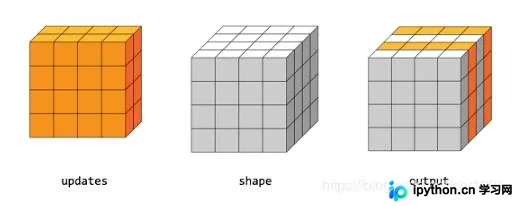
indices = tf.constant([[0], [2]])
updates = tf.constant([[[5, 5, 5, 5], [6, 6, 6, 6],
   [7, 7, 7, 7], [8, 8, 8, 8]],
   [[5, 5, 5, 5], [6, 6, 6, 6],
   [7, 7, 7, 7], [8, 8, 8, 8]]])
shape = tf.constant([4, 4, 4])
scatter = tf.scatter_nd(indices, updates, shape)
with tf.Session() as sess:
 print(sess.run(scatter))
此时,indices的形状为(2,1),updates的形状为(2,4,4),shape的形状为(4,4,4)。
indices.shape[:-1]+shape[indices.shape[-1]:]=(2,)+(4,4)=(2,4,4)最终得到的张量结果为:
[[[5, 5, 5, 5], [6, 6, 6, 6], [7, 7, 7, 7], [8, 8, 8, 8]],
 [[0, 0, 0, 0], [0, 0, 0, 0], [0, 0, 0, 0], [0, 0, 0, 0]],
 [[5, 5, 5, 5], [6, 6, 6, 6], [7, 7, 7, 7], [8, 8, 8, 8]],
 [[0, 0, 0, 0], [0, 0, 0, 0], [0, 0, 0, 0], [0, 0, 0, 0]]]
tf.scatter_nd函数参数说明:
indices:Tensor类型,必须为int32或int64,表示索引值张量。
updates:Tensor类型,表示分散到输出中的更新值。
shape:Tensor类型,必须与indices具有相同的类型,为一维张量,表示输出张量的形状。
name:操作的名称,可选参数。
关于返回值:
此函数返回一个Tensor,其类型与updates相同。这是一个具有shape形状的新张量,初始值为0,部分值根据indices使用updates进行更新。
tf.scatter_nd_update:更新可变张量
tf.scatter_nd_update函数详解
函数原型如下所示。
scatter_nd_update(
 ref,
 indices,
 updates,
 use_locking=True,
 name=None
)
tf.scatter_nd_update同样根据indices将updates中的值赋值到目标张量,但与scatter_nd不同,它是直接赋值到ref变量中。
ref是秩为P的张量,indices是秩为Q的张量。
indices是整数类型的张量,其形状需满足特定结构 。
indices最内部的维度对应于ref的某个元素或切片。
updates的形状为 ,是秩为Q-1+P-K的张量。
例如,若要将形状为(4,)的向量赋值到形状为(8,)的ref中,操作如下。
ref = tf.Variable([1, 2, 3, 4, 5, 6, 7, 8])
indices = tf.constant([[4], [3], [1] ,[7]])
updates = tf.constant([9, 10, 11, 12])
update = tf.scatter_nd_update(ref, indices, updates)
with tf.Session() as sess:
 print sess.run(update)
执行后可得到更新后的ref:
[1, 11, 3, 10, 9, 6, 7, 12]tf.scatter_nd_update函数参数说明:
ref:一个可变的Tensor。
indices:一个int32或int64 Tensor,用于对ref进行索引。
updates:一个Tensor,必须与ref具有相同的类型,表示更新值张量。
use_locking:可选的bool类型参数。如果为True,则赋值操作将受锁保护;否则行为不确定,但可能表现出较少的竞争。
name:操作的名称,可选参数。
关于返回值:
返回经过更新后的ref。
以上关于TensorFlow中张量提取值和赋值的介绍到此结束,希望能为读者提供参考。
免责声明:本文内容仅供参考,不代表本站观点。转载或引用请注明出处。









