

Python List 源码深度解析:结构、扩容与内存管理

本文深入解析 Python List 的 C 语言底层实现。从 PyListObject 结构体字段出发,详细阐述列表创建、元素插入时的动态扩容算法(0, 4, 8, 16...),以及 pop、clear 和 del 操作的内部逻辑。重点解析引用计数、双向链表维护及 free_list 缓存机制如何优化内存分配效率。
一、列表结构体
在 C 语言层面,Python 的列表由特定的结构体定义。该结构体不仅管理元素,还涉及内存引用计数与链表节点指针,具体定义可见 listobject.c 源码。
lists = []
list.append('name')
list.append('age')
list.append('grade')
typedef struct{
	struct _object *_ob_next;
	struct _object *_ob_prev; 	// python内部将对象放在链表进行内存管理
	Py_ssize_t ob_refcnt;		// 引用计数器,就是多少变量用了它
	PyObject **ob_item;			// 指针的指针,存列表的元素
	Py_ssize_t ob_size;			// 已有元素个数
	Py_ssize_t allocated;		// 列表容量,可容纳个数
} PyListObject;
c源码来自 listobject.c
二、创建列表
name_list = [ ]
PyObject *
PyList_New(Py_ssize_t size)
{
    PyListObject *op;
    size_t nbytes;
#ifdef SHOW_ALLOC_COUNT
    static int initialized = 0;
    if (!initialized) {
        Py_AtExit(show_alloc);
        initialized = 1;
    }
#endif
    // 缓存机制
    if (size < 0) {
        PyErr_BadInternalCall();
        return NULL;
    }
    /* Check for overflow without an actual overflow,
     *  which can cause compiler to optimise out */
    if ((size_t)size > PY_SIZE_MAX / sizeof(PyObject *))
        return PyErr_NoMemory();
    nbytes = size * sizeof(PyObject *);
    if (numfree) {
        numfree--;
        op = free_list[numfree];
        _Py_NewReference((PyObject *)op);
#ifdef SHOW_ALLOC_COUNT
        count_reuse++;
#endif
    } else {
        op = PyObject_GC_New(PyListObject, &PyList_Type);
        if (op == NULL)
            return NULL;Py
#ifdef SHOW_ALLOC_COUNT
        count_alloc++;
#endif
    }

    if (size <= 0)
        op->ob_item = NULL;
    else {
        op->ob_item = (PyObject **) PyMem_MALLOC(nbytes);
        if (op->ob_item == NULL) {
            Py_DECREF(op);
            return PyErr_NoMemory();
        }
        memset(op->ob_item, 0, nbytes);
    }
    Py_SIZE(op) = size;  // 元素个数
    op->allocated = size;   // 容量
    _PyObject_GC_TRACK(op); //放到双向链表进行维护
    return (PyObject *) op; //返回列表的指针
}
三、添加元素
当向 list 插入单个元素时,系统会先检查并可能扩容连续内存地址(即 capacity)。随后在内存中创建待插入内容的对象指针 p,并将该地址 *p 存入 list 的空间中。因此,PyListObject 的 ob_item 字段是指向指针的指针,用于存储实际元素的地址。
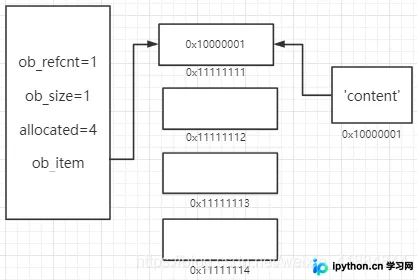
扩容的曲线一般就是0,4,8,16,24…
// 添加元素
static int
app1(PyListObject *self, PyObject *v)
{
    // 获取实际元素个数
    Py_ssize_t n = PyList_GET_SIZE(self);

    assert (v != NULL);
    if (n == PY_SSIZE_T_MAX) {
        PyErr_SetString(PyExc_OverflowError,
            "cannot add more objects to list");
        return -1;
    }

    // 计算当前容量和内部元素个数
    // 直接添加元素/扩容添加
    if (list_resize(self, n+1) == -1)
        return -1;
    // 将元素添加到ob_item,v
    Py_INCREF(v);
    PyList_SET_ITEM(self, n, v);
    return 0;
}
- 扩容
// 扩容机制
 // newsize: 已存在元素个数+1
static int
list_resize(PyListObject *self, Py_ssize_t newsize)
{
    PyObject **items;
    size_t new_allocated;
    Py_ssize_t allocated = self->allocated; // 当前的容量

    // 1,容量大于个数
    // 2,个数大于容量的一半(容量足够且没有内存浪费)
    if (allocated >= newsize && newsize >= (allocated >> 1)) {
        assert(self->ob_item != NULL || newsize == 0);
        Py_SIZE(self) = newsize;
        return 0;
    }

    /*
     * The growth pattern is:  0, 4, 8, 16, 25, 35, 46, 58, 72, 88, ...
     */
     // 扩容机制的算法
    new_allocated = (newsize >> 3) + (newsize < 9 ? 3 : 6);

    /* check for integer overflow */
    if (new_allocated > PY_SIZE_MAX - newsize) {
        PyErr_NoMemory();
        return -1;
    } else {
        new_allocated += newsize;
    }

    if (newsize == 0)
        new_allocated = 0;
    // 扩容/缩容(涉及原来元素的迁移)
    items = self->ob_item;
    if (new_allocated <= (PY_SIZE_MAX / sizeof(PyObject *)))
        PyMem_RESIZE(items, PyObject *, new_allocated);
    else
        items = NULL;
    if (items == NULL) {
        PyErr_NoMemory();
        return -1;
    }
    // 赋值,更新个数和容量
    self->ob_item = items;
    Py_SIZE(self) = newsize;
    self->allocated = new_allocated;
    return 0;
}
四、移除元素
list.pop() 删除最后一个元素时,仅需修改 size 字段,无需清除底层数据,下次 append 可直接覆盖该位置。 若通过指定索引位置移除元素,后续元素需向前补位以维持连续性。
static PyObject *
listpop(PyListObject *self, PyObject *args)
{
    Py_ssize_t i = -1;
    PyObject *v;
    int status;

    if (!PyArg_ParseTuple(args, "|n:pop", &i))
        return NULL;

    if (Py_SIZE(self) == 0) {
        /* Special-case most common failure cause */
        PyErr_SetString(PyExc_IndexError, "pop from empty list");
        return NULL;
    }
    if (i < 0)
        i += Py_SIZE(self);
    if (i < 0 || i >= Py_SIZE(self)) {
        PyErr_SetString(PyExc_IndexError, "pop index out of range");
        return NULL;
    }
    v = self->ob_item[i];
    // 删除最后一个,仅改变size
    if (i == Py_SIZE(self) - 1) {
        status = list_resize(self, Py_SIZE(self) - 1);
        assert(status >= 0);
        return v; /* and v now owns the reference the list had */
    }
    Py_INCREF(v);
    // 不是最后一个,需要移动数据位置
    status = list_ass_slice(self, i, i+1, (PyObject *)NULL);
    assert(status >= 0);
    /* Use status, so that in a release build compilers don't
     * complain about the unused name.
     */
    (void) status;

    return v;
}
五、清空
list.clear()
static int
list_clear(PyListObject *a)
{
    Py_ssize_t i;
    PyObject **item = a->ob_item;
    if (item != NULL) {
        i = Py_SIZE(a);
        // 各个元素设置为空
        Py_SIZE(a) = 0;
        a->ob_item = NULL;
        a->allocated = 0;
        // 引用计数器-1
        while (--i >= 0) {
            Py_XDECREF(item[i]);
        }
        PyMem_FREE(item);
    }

    return 0;
}
六、销毁
del list
销毁列表对象涉及一系列底层操作: 首先将列表的引用计数减 1。 若引用计数仍大于 0,说明仍有其他变量引用该列表,则不执行销毁操作。 若引用计数降为 0,表示无人使用,进入回收流程。
- 处理列表的元素,将所有引用计数-1(GC回收0计数)
- ob_item=0,ob_size=0,ob_allocated=0
- 将列表从双向链表移除,可以销毁
- 为了提高效率,Python 在结束期内部维护一个 free_list 缓存池,预存 80 个无使用的 list 对象。当再次创建列表时,直接从中取出初始化;若缓存已满(已达 80 个),则 del 时直接在内存中销毁该对象。
static void
list_dealloc(PyListObject *op)
{
    Py_ssize_t i;
    // 判断引用计数是否为0
    PyObject_GC_UnTrack(op);
    Py_TRASHCAN_SAFE_BEGIN(op)
    if (op->ob_item != NULL) {
        i = Py_SIZE(op);
        while (--i >= 0) {
            Py_XDECREF(op->ob_item[i]);
        }
        PyMem_FREE(op->ob_item);
    }
    // free_list没有80个的话缓存这个list
    if (numfree < PyList_MAXFREELIST && PyList_CheckExact(op))
        free_list[numfree++] = op;
    else
        Py_TYPE(op)->tp_free((PyObject *)op);
    Py_TRASHCAN_SAFE_END(op)
}
就是说创建列表时,实际上不会直接开辟内存,而是先看看free_list
# 两次list的地址相同
>>> list1=[1,2,3]
>>> id(list1)
69070216L
>>> del list1
>>> list2=[0,0,0]
>>> id(list2)
69303304L
>>>
到此这篇关于Python源码解析之List的文章就介绍到这了,更多相关Python List内容请搜索本站以前的文章或继续浏览下面的相关文章希望大家以后多多支持本站!
免责声明:本文内容仅供参考,不代表本站观点。转载或引用请注明出处。









