

Python实现游戏地图最短路径搜索:基于广度优先与回溯算法

发布时间:2026-10-13| 3人浏览过
本文介绍使用Python解决游戏地图中从起点到终点的最短路径寻找问题。通过矩阵模拟地图,利用广度优先搜索(BFS)进行多层扩展以确定可达性,并结合回溯法从终点反向追踪标记值较小的相邻点来构建具体路径。文章详细阐述了算法设计思路、核心代码实现及运行结果分析,展示了如何处理障碍区与可行区域。
一、题目要求
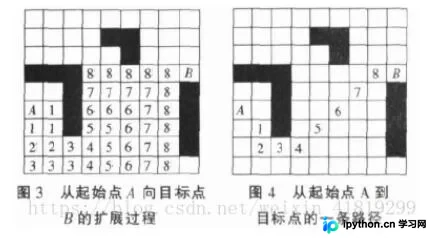
参考下图完成游戏地图中从起点到目标点的最短路径寻找问题。
二、设计思路
首先对游戏地图进行设定,采用矩阵形式来模拟游戏地图。将可行的区域位置赋值为0,障碍区赋值为inf(无穷大)。考虑到地图尺寸,将起始点和终点区域的值赋为99。
从Start点A开始向外层扩展,每扩展一层,pathlen(路径长度)加一。List Q用于存储当前需要扩展的点,list P用于存储当前扩展层。当扩展到End点B时,扩展结束,路径可规划。当Q为空时,本次层扩展结束,检查P,若P非空,从P层向外扩展;若P为空,则End点B无法到达。
寻找最短路径时,从End点B开始,寻找当前点附近8个点的标记中比当前点标记小的点,直到标记为1为止。
三、程序主体
# -*-coding:gbk -*-
from numpy import *
dirs = [(1,1),(1,0),(1,-1),(0,-1),(-1,-1),(-1,0),(-1,1),(0,1)] # 四邻位置:从右下角开始顺时针得到,是按坐标差得到的
def find_path(oldmap,A,B):
 oldmap[A[0], A[1]] = 99
 oldmap[B[0], B[1]] = 99
 [a,b]=oldmap.shape
 pathmap=oldmap.copy()
 Q=[]#存储扩展节点
 P=[]#往外一层
 pathlen=1
 if A==B:
  print('start point is equal to end point')
  return True
 current=A
 while (True):
  for i in range(8):
   neighbor=[current[0]+dirs[i][0], current[1]+dirs[i][1]]
   if neighbor==B:
    print('the way is found')######################wrong
    print('中间过程')
    print(oldmap)
    find_way(oldmap,pathmap,A,B,a,b)#####调用路径函数
    return True
   if (neighbor[0]>=0 and neighbor[1]>=0 and neighbor[0]<a and neighbor[1]<b and oldmap[neighbor[0],neighbor[1]]==0):
    P.append(neighbor)
    oldmap[neighbor[0],neighbor[1]]=pathlen

  if Q==[]:
   if P ==[]:
    print(oldmap) ##############
    print('No path')
    return False
   else:
    Q.extend(P)
    P=[]
    pathlen += 1

  else:
   current=Q.pop()

###################寻找最短路径
def find_way(oldmap,pathmap,A,B,a,b):
 currentpos=B
 while (oldmap[currentpos[0],currentpos[1]]!=1):
  for i in range(8):
   neighborpos=[currentpos[0]+dirs[i][0], currentpos[1]+dirs[i][1]]
   if (neighborpos[0] >= 0 and neighborpos[1] >= 0 and neighborpos[0] < a and neighborpos[1] < b and oldmap[neighborpos[0],neighborpos[1]]!=0):
    if oldmap[neighborpos[0],neighborpos[1]]<oldmap[currentpos[0],currentpos[1]]:
     pathmap[neighborpos[0],neighborpos[1]]=oldmap[neighborpos[0],neighborpos[1]]
     currentpos=neighborpos
     break
 print('the way:')
 print(pathmap)
四、主函数
def main():
 map =mat([[0, 0, 0, 0, 0, 0, 0, 0, 0, 0, 0, 0, 0],
    [0, 0, 0, 0, inf,inf, 0, 0, 0, 0, 0, 0, 0],
    [0, 0, 0, 0, 0,inf, 0, 0, 0, 0, 0, 0, 0],
    [inf,inf,inf, 0, 0, 0, 0, 0, 0, 0, 0, 0, 0],
    [0, 0,inf, 0, 0, 0, 0, 0, 0, 0, 0, 0, inf],
    [0, 0,inf, 0, 0, 0, 0, 0, 0, 0, 0, 0, inf],
    [0, 0,inf, 0, 0, 0, 0, 0, 0, 0, 0, 0,inf],
    [0, 0, 0, 0, 0, 0, 0, 0, 0, 0, 0, 0, inf],
    [0, 0, 0, 0, 0, 0, 0, 0, 0, 0, 0, 0, 0],])
 print('最初地图')
 print(map)
 print('**********************************')
 A = [5, 0]
 # B=[5,0]
 B = [3, 12]
 find_path(map,A, B)


if __name__=='__main__':
 main()
五、运行结果

六、结果分析
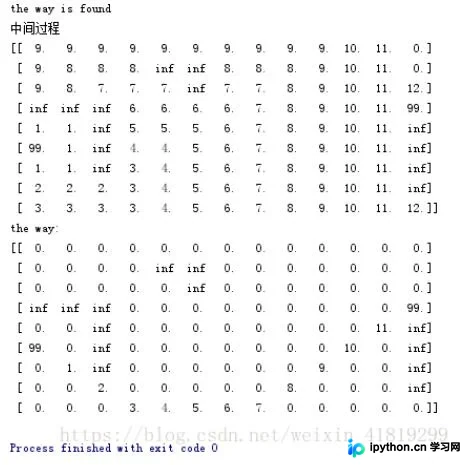
由中间过程对应的矩阵可知,共经历了12次向外层扩展,第12次扩展即可将目标点包含进去。最短路径如the way对应的矩阵所示,是通过一种类似梯度下降的方法得到的。
以上就是本文的全部内容,希望对大家的学习有所帮助,也希望大家多多支持本站。
免责声明:本文内容仅供参考,不代表本站观点。转载或引用请注明出处。









