

Python实现简单神经网络算法:从二层到三层详解

发布时间:2026-10-13| 4人浏览过
本文详细介绍如何使用Python实现简单的神经网络算法,涵盖二层(仅含输入与输出层)和三层(含输入、隐含及输出层)两种结构。通过具体代码示例,解析Sigmoid函数、权重初始化、前向传播及反向传播误差校正过程,帮助初学者理解神经网络的基本原理与实现细节。
本文介绍使用Python实现简单神经网络算法的具体方法,供读者参考学习。
首先展示Python实现的二层神经网络结构。
该网络结构包含输入层和输出层两部分。
import numpy as np

#sigmoid function
def nonlin(x, deriv = False):
  if(deriv == True):
    return x*(1-x)
  return 1/(1+np.exp(-x))

#input dataset
x = np.array([[0,0,1],
       [0,1,1],
       [1,0,1],
       [1,1,1]])

#output dataset
y = np.array([[0,0,1,1]]).T

np.random.seed(1)

#init weight value
syn0 = 2*np.random.random((3,1))-1

for iter in xrange(100000):
  l0 = x             #the first layer,and the input layer
  l1 = nonlin(np.dot(l0,syn0))  #the second layer,and the output layer


  l1_error = y-l1

  l1_delta = l1_error*nonlin(l1,True)

  syn0 += np.dot(l0.T, l1_delta)
print "outout after Training:"
print l1
具体变量定义如下:\n\nl0表示输入层。
l1表示输出层。
syn0表示初始化的权值矩阵。
l1_error表示计算得到的误差值。
l1_delta表示用于误差反向传播的校正系数。
func nonlin为Sigmoid激活函数。
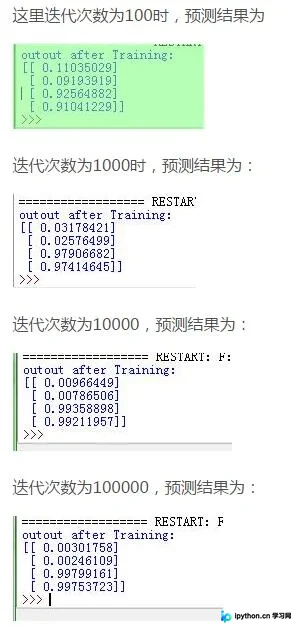
从实验结果可见,随着迭代次数增加,预测结果逐渐接近理想值,但相应的计算耗时也随之增加。
接下来展示Python实现的三层神经网络结构。
该网络结构包含输入层、隐含层和输出层三个部分。
import numpy as np

def nonlin(x, deriv = False):
  if(deriv == True):
    return x*(1-x)
  else:
    return 1/(1+np.exp(-x))

#input dataset
X = np.array([[0,0,1],
       [0,1,1],
       [1,0,1],
       [1,1,1]])

#output dataset
y = np.array([[0,1,1,0]]).T

syn0 = 2*np.random.random((3,4)) - 1 #the first-hidden layer weight value
syn1 = 2*np.random.random((4,1)) - 1 #the hidden-output layer weight value

for j in range(60000):
  l0 = X            #the first layer,and the input layer
  l1 = nonlin(np.dot(l0,syn0)) #the second layer,and the hidden layer
  l2 = nonlin(np.dot(l1,syn1)) #the third layer,and the output layer


  l2_error = y-l2    #the hidden-output layer error

  if(j%10000) == 0:
    print "Error:"+str(np.mean(l2_error))

  l2_delta = l2_error*nonlin(l2,deriv = True)

  l1_error = l2_delta.dot(syn1.T)   #the first-hidden layer error

  l1_delta = l1_error*nonlin(l1,deriv = True)

  syn1 += l1.T.dot(l2_delta)
  syn0 += l0.T.dot(l1_delta)
print "outout after Training:"
print l2
以上就是本文的全部内容,希望对大家的学习有所帮助,也希望大家多多支持本站。
免责声明:本文内容仅供参考,不代表本站观点。转载或引用请注明出处。









